
Female Survivor (Anonymous)
Attended Re-Creation Retreat
For most of my life I had issues with my family, mostly my dad. When I was 15 and 16, I struggled when I found out I wasn’t straight and hated myself for it, in part because my family is very Christian and conservative. I found during that time my depression got a lot worse. The friend that I was attracted to had simultaneously cut me off from their life entirely. I felt abandoned, coped by harming myself, and had built up a lot of self-hatred. I attempted suicide months later, and shortly after we moved from my home of 16 years to a new state. I continued to spiral mentally.
Moving and family dynamics pushed my mental health over the edge, but it was ultimately my dad physically assaulting me that led me to mental health treatment facilities. When I tried to run away from home after being physically assaulted, my parents called the sheriff to transfer me to an ER and accused me of assaulting my father. During that incident, I was pinned to the floor in pain while my dad screamed at me for a long time, and my mom just stared, doing nothing.
I had been depressed when I was younger, but during those years it was especially difficult. After about a month of treatment in an acute psychiatric facility, I was discharged and became suicidal in my home environment. I told my mom I needed to be sent back. I struggled every night with thoughts of running into the street to kill myself. The facility didn’t have enough beds, so I was transported to a different psychiatric ward in South Carolina until a bed came open. Due to my insurance refusing to cover my stay, I went from the acute unit to a different residential facility for a month, and then a separate residential for another month. It was finally verbalized to me that insurance was running out again, which meant I had to either go home or go to RCR.
When I arrived, my only expectation was that RCR would be a safer place for me than home. I also understood I needed help to feel better. Initially, I remember RCR being odd in comparison to the previous facilities I had been in how it was run. I wouldn’t say I felt unsafe, but it wasn’t a place of comfort or an ideal place for recovery.
The program was very rigid. I remember when I would wake up and either see the bars of the bunk bed or the ceiling I would think “this is all I will ever see” and felt completely trapped there. My parents had decided for me that I could not have a home visit or leave the program early. In essence, I had to complete the program if I was ever going to leave, which took residents 6 months at a minimum. What didn’t help was the program’s point system that required set amounts of points in order to advance in the program. The points you earned per day were insufficient considering how easily their consequence system could take points away.
School was okay, although learning primarily online was less engaging than a classroom setting, and it took longer to complete work. We exercised almost every day, and I remember it typically being very intense in comparison to the PE I experienced in public school. Here we sometimes engaged in sports during PE like volleyball that I did enjoy and became quite good at. We would occasionally do improv or act in plays in theater/drama, which I found fun. We did choir, which was cool, especially being able to do duets and perform at the town festival. I enjoyed being in the running group that trained for the half-marathon and 5K. Halloween at RCR was a great memory as we had a lot of laughs creating the haunted hallway.
During the beginning of my stay, I was put in room 1 where I first met ██████. We both had insomnia and would stay up late talking and playing 20 questions. I was there for her when she woke up from a night terror. She was there for me when my grandpa passed and took away what I was going to use to hurt myself. We weren’t able to talk much due to the program rules but definitely became closer and protective over each other while in the same room and got to know each other better. I would definitely say we were a huge support and comfort to each other during our stay at RCR.
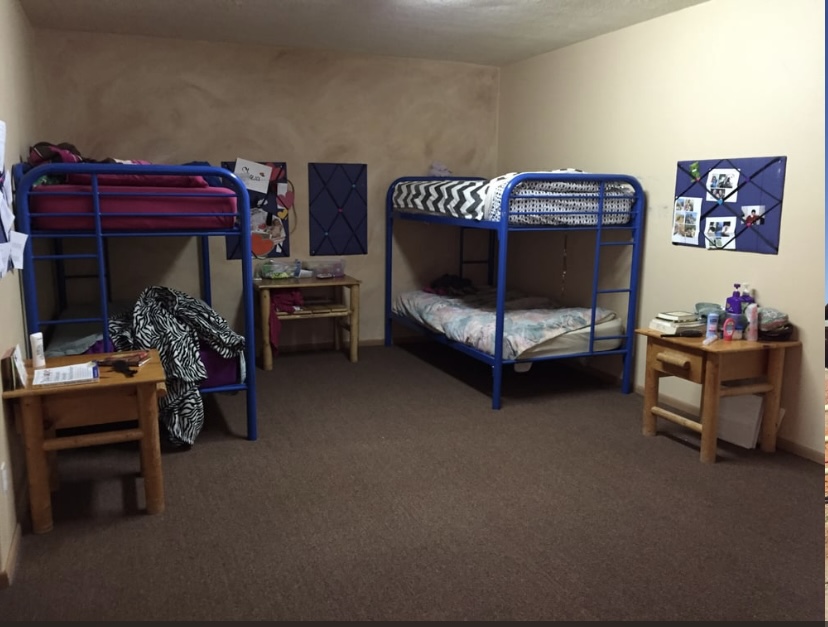
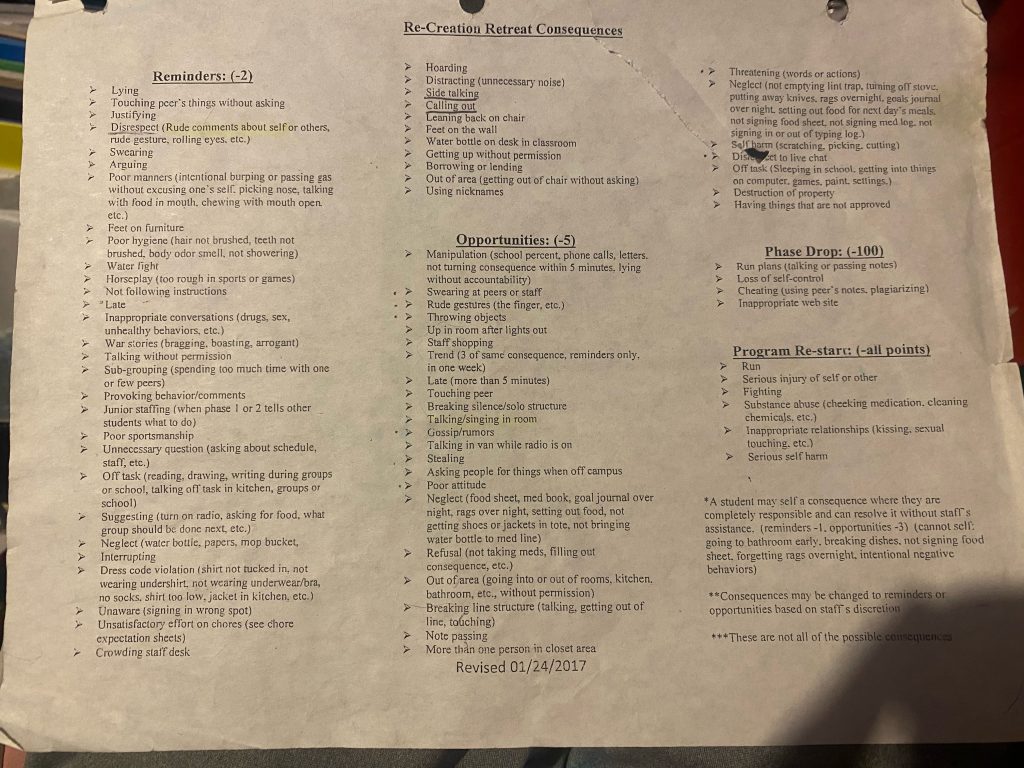
There was one day in particular when we were sitting next to each other in our room and I put my head on her shoulder. A staff member █████ passed by and wrote us up for “cuddling,” resulting in us being put on “silence” from each other. I was immediately removed from the room, and we were no longer allowed to speak with permission or be within proximity of each other. We then became closer by writing notes all of the time. Note passing was against the rules but we got away with it. The day she was pulled from the program I was devastated. I was visibly upset that day, not wanting to do anything, and we happened to be marathoning the Twilight movies. ██████ made an insensitive comment that “the movie must be getting to her” while I was laying on the floor crying.
In residents with depression especially, self-isolation tends to be a prominent issue. So, to prohibit residents from talking to each other was not helpful. I know feeling depressed can make you feel alone, which can be exacerbated with no connection. In other programs I was able to communicate with my peers freely, which helped my mental state tremendously, and was likely the reason I was well enough to be discharged from my first treatment facility.
Another major issue residents may be experiencing is lack of self-esteem, and the main purpose of the consequence system was to shame residents for various reasons. One such reason could be an “indirect” – looking in the direction of someone else – leading you to be punished by losing points and by writing a 1,000 word essay as to why what you did was wrong. Through this sort of punishment, residents are forced to reflect on the error in their actions and in themselves. There doesn’t seem to be any other purpose in this other than to shame residents. In other facilities, residents aren’t made to feel worse about themselves even when committing an act like harming themselves or others, whereas at RCR, residents were made to feel worse for something as simple as making eye contact. I observed other facilities enforce consequences like having staff monitor you if you are a danger to yourself, or they may temporarily put you in an isolation room if you are a risk to others. While these consequences are purposeful and promote the safety of residents, RCR did not seem concerned in the underlying damage their consequence system could cause.
The consequence system overall was extreme. I can understand a consequence for being late, but otherwise I do not feel these consequences set residents up for success. Rather, they tended to be unnecessary and arbitrary consequences, including actions such as not pushing in your chair, talking to another peer without permission, having a single smudge on a sink, and not enforcing the rules with your peers, along with countless others.
I was vegan before arriving at RCR, and despite having prior accommodations at other facilities, RCR told me they couldn’t accommodate that. At meals, we were required to eat 50% of our plate. I was given a whole plate of eggs, which grossed me out as I had been vegan for some time. I had to scrape food to one side to make it seem like I had eaten. I was still forced to eat some of the eggs to avoid getting in trouble, even after addressing my dietary restrictions.
███████████████ was neglectful as a therapist. He did not see me regularly and would lie to my parents about meeting with me. He saw me maybe once a month if I’m being generous, and during the sessions he was not helpful and we did not make progress. Meanwhile, in previous treatment facilities I received almost daily or regular weekly therapy that I did find helpful.
There were staff members that made a positive impact on me personally and in the environment at RCR (Protect █████, ██████, ███, █████, ██████, ████, ███ █, ██████). These staff helped support and uplift me. I definitely think there were staff members that could have been more compassionate. Some peers were unfairly targeted by staff more than others, like █████, ██████, █████, ████, ██████, and ██████.
I remember with █████, the staff █████ had put her in a restraint but was more so slamming her to the floor and holding her there for a while in pain. It didn’t seem like a proper restraint. After treatment team denied me a second time for phase advancement in the program without valid reason, I became upset and needed a moment in the other building. █████ threatened to put me in a restraint if I didn’t go back.
There were instances of discrimination I witnessed that residents should have been protected from. With ██████, staff were especially disrespectful, disregarding ███████ pronouns (he/him). Staff told us we had to refer to ██████ as “she/her” or we would face consequences. Pressured to follow the rules, most peers felt forced to discriminate against ██████, calling him by the incorrect pronouns. Knowing how hurtful this must have been for ██████, I did not participate in this. █████ was also discriminated against regarding gender, and staff members said they would not respect that.
Self-harm was an issue there, not just for me. Many residents talked about hurting themselves with pen caps, erasers, glass from the track, and broken light bulbs. These things were provided to us or readily available. I also witnessed injuries that other peers had inflicted on themselves. I had access to a blade that staff did not properly confiscate from me after I told them to take it from me. I ended up hurting myself with that blade and can recall running the track with cut up ankles and blood in my socks. I was also harming myself by punching the wall, slamming my head on the wall, and biting myself until I was black and blue. Nothing was done to address or prevent any of this. The time that I punched the wall resulted in my hand becoming extremely swollen. ████ was in the room with me, saw what happened, and had to reason with ██████ to get me ice to treat the injury. After receiving the ice, nothing was done to intervene and prevent me from further injuries, despite my background of self-harm.
The fact that medical attention wasn’t given is really concerning. I remember sneaking a rag with water and soap to ██████ because he had a large untreated cut on his hand that looked as if he had sawed into it. I noticed █████ had self-harmed by cutting her shoulders. I recall blood in the sink from when she did. I know she still has scars as an adult from this. At other facilities, unsafe items were not readily available to hurt yourself with. RCR should have done a better job preventing the grounds from being so harmful.
When it came to transparency on phone calls and in letters, everything was monitored or read so your parents couldn’t know the truth of what was going on. If you said something staff did not like, you would receive a consequence. Likewise, if your letter stated something staff did not approve of, they would rip it up and have you rewrite it.
Overall, the program was about compliance more than helping you. It was the people that sacrificed their honesty and expression who graduated the program. Regardless of the state of mind you were in, you could leave if you were in compliance with the program rules. This ultimately leaves you unprepared to face the problems that brought you to RCR in the first place.
I had no support system other than a new therapist upon leaving the program, which didn’t greatly help me recover. I haven’t been able to figure out something to help me overcome the things I struggle with since my experience at the program. While I did gain valuable knowledge from the program, the most practical and helpful knowledge came from seminar, which was separate from RCR (TurningLeaf).
The program is not what I needed at the time, I needed regular therapy and was not provided that. I rarely saw a doctor and never had a proper intake consultation with the doctor either, which is important in the proper diagnosis and treatment of a patient. I wish we had been able to speak with one another. If the program wasn’t so strict and we could exist without unnecessary consequences, it could have been more beneficial in achieving recovery.
I was still not in a good relationship with my family which I figured out the same day I graduated RCR. It was extremely tense between us. There were so many problems that were unresolved. The family therapy RCR is said to provide was so scarce and ineffective. Despite staying at RCR for a year, I only recall less than 5 of these sessions. During my comparatively short stays at other facilities, the family therapy I received was significantly better and actually made a slight difference. Having been cut off from the world and having it prolonged by RCR hurt any friendships I wanted to continue. I haven’t found solace in any community or support groups since. I feel resources for mental health are scarce.
Mental health treatment is lacking in a lot of way. There needs to be an ethical and effective ways of addressing those in need, that reminds them they are more than their issues and deserve to enjoy life again.
-Anonymous
Disclaimer
The survivor stories shared on this blog are personal accounts and reflect the experiences and opinions of the individuals who have chosen to share them. While we strive for accuracy, these narratives are based on personal recollections and may include subjective perspectives.
Names and identifying details may have been changed or redacted to protect privacy and safety. The content provided is for informational and awareness purposes only and is not intended as legal or professional advice.
Past Peers Protection Project does not make any representations regarding the accuracy of third-party claims. If you believe any information is inaccurate or wish to report concerns, please contact us.
If you are a survivor seeking support, we encourage you to reach out to trusted professionals or advocacy organizations for guidance and assistance.
Leave a Reply